QD-OLED
QD-OLED Explained: The Hybrid That Beats Both OLED and QLED
QD-OLED combines the perfect blacks of OLED with the colour volume and brightness of quantum dots. The Samsung S95D and Sony A95L are the best TVs you can buy in 2026. Here is why they matter, and who should actually buy one.
The Verdict
If you can afford it and are buying a TV you plan to keep for 5+ years, QD-OLED is the single best premium panel technology of 2026. For buyers in dark-to-moderate rooms who do not need the absolute maximum brightness, WOLED at $1,000-$1,500 less is the rational choice. The 80% price premium for QD-OLED is justified for premium buyers; it is not justified for budget-conscious buyers.
How QD-OLED Actually Works
Standard WOLED panels (used by LG, Sony on A80L, Philips, Panasonic) generate white light from organic compounds and then filter that white light through a colour filter array to produce red, green, and blue sub-pixels. The colour filter absorbs a significant portion of the emitted light, typically losing 25-35% efficiency in the process. This is a fundamental physical constraint of the colour-filter approach.
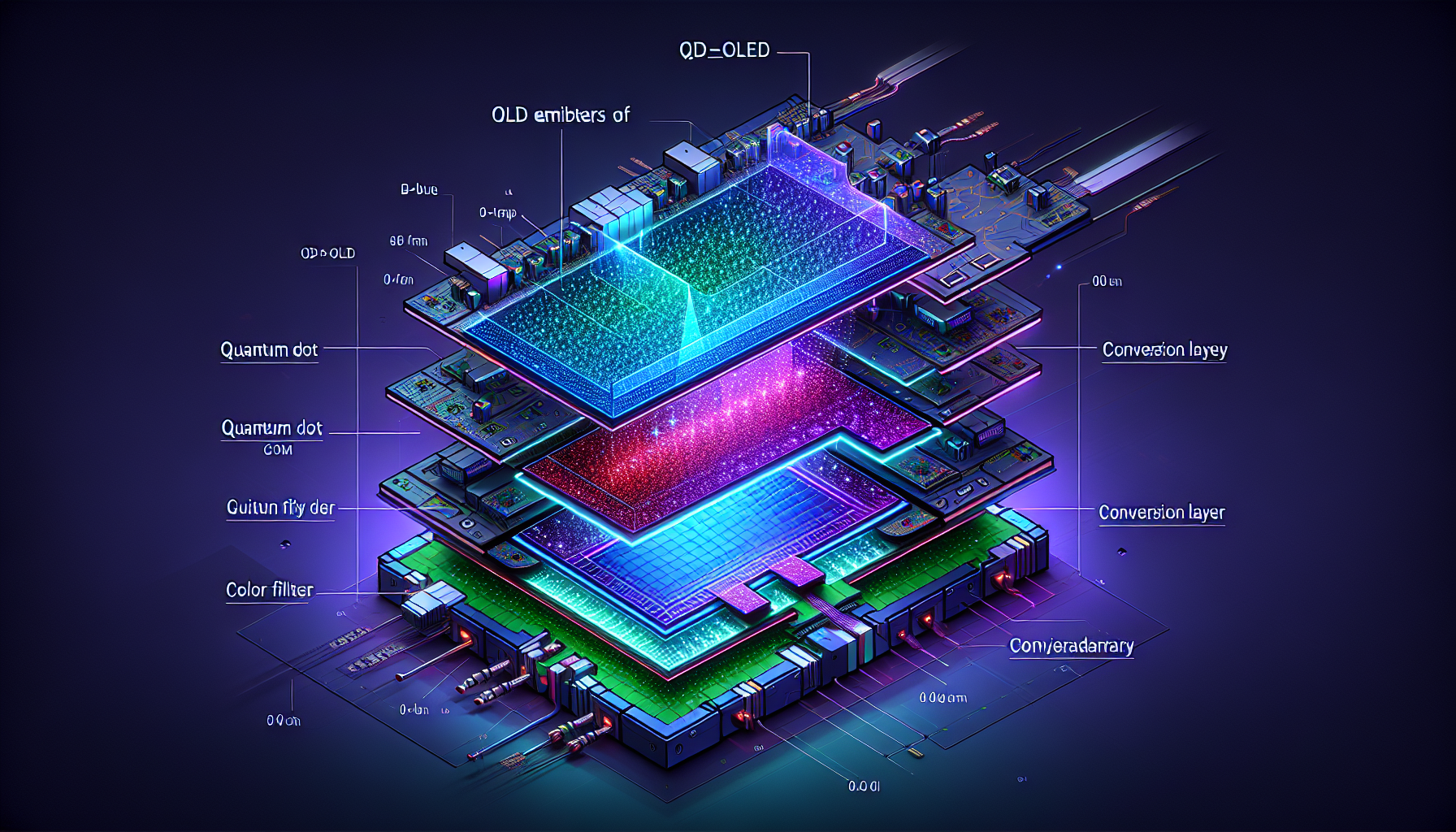
QD-OLED takes a different path. The emissive layer uses only blue organic compounds, generating pure blue light across the panel. In front of this blue OLED layer sits a quantum-dot colour conversion layer. Quantum dots are semiconductor nanocrystals tuned to specific sizes. When excited by the blue OLED light, they emit precisely tuned red and green wavelengths -- the sub-pixel creates its own colour without a filter absorbing any of the emitted light. The blue sub-pixels pass through directly.
The practical result: QD-OLED panels achieve 25-40% higher peak brightness than equivalent WOLED panels at the same power budget. They also achieve higher colour volume, meaning colours stay saturated at higher brightness levels rather than washing out as brightness increases. The DCI-P3 coverage at peak brightness is measurably higher for QD-OLED than WOLED.
WOLED Architecture
- White OLED emissive layer
- Colour filter array (RGB)
- Absorbs 25-35% of light
- Used by: LG, Sony A80L, Philips
- Peak: 1,100-1,500 nits typical
QD-OLED Architecture
- Blue OLED emissive layer
- Quantum-dot colour conversion layer
- No colour filter, minimal light loss
- Used by: Samsung, Sony A95L
- Peak: 1,700-2,100 nits typical
Measurement Data: QD-OLED vs WOLED
All nits figures are Rtings-style measured values, not manufacturer specifications. Last verified April 2026.
| Model | Panel | Peak 10% | DCI-P3 | 65" Price |
|---|---|---|---|---|
| LG C5 | WOLED | 1,100-1,300 nits | 98.5% | $1,499 |
| LG G5 | WOLED | 1,300-1,500 nits | 98.8% | $2,499 |
| Samsung S95D | QD-OLED | 1,800-2,100 nits | 99.2% | $2,699 |
| Sony A95L | QD-OLED | 1,700-2,000 nits | 99.0% | $3,299 |
Why QD-OLED Costs 20-40% More
Samsung Display's QD-OLED manufacturing process requires two distinct deposition steps (the blue OLED layer and the quantum-dot layer) where WOLED uses a simpler WRGB compound deposition process that LG Display has optimised over many product generations. Samsung's process has a lower yield rate at equivalent panel sizes, and the quantum-dot material itself has non-trivial material costs.
At the consumer level, the price gap has narrowed from the 50-60% premium at QD-OLED's 2022 launch to roughly 30-40% in 2026. Samsung S95D 65-inch at $2,699 vs LG C5 65-inch at $1,499 represents an 80% price premium -- at the high end of what the brightness and colour-volume advantage justifies. The Sony A95L at $3,299 adds Sony's image processing premium on top of the panel cost.
The price premium is most justified for buyers who keep TVs for 7-10 years, viewers with mixed-light rooms, and those who prioritise peak HDR specular highlights in cinema content. It is least justified for dark-room only film viewers on a budget, where WOLED's contrast advantage is equal and the brightness gap is invisible in a properly dark room.
2026 Models That Use QD-OLED Panels
Samsung S95D
QD-OLEDSamsung's flagship QD-OLED. Available 55, 65, 77, 83 inch. 4 HDMI 2.1 ports. Matte anti-reflective coating on all sizes. Samsung's best gaming TV with 4K/144Hz on some inputs. No Dolby Vision (Samsung's deliberate choice) -- uses HDR10+ instead.
Sony A95L
QD-OLEDSony's flagship QD-OLED. Available 55, 65, 77 inch. Uses Samsung Display's QD-OLED panel with Sony's XR Cognitive Processor and Acoustic Surface Audio+. The best-calibrated TV in 2026 out of the box. Supports Dolby Vision, HDR10, HLG. Key limitation: only 2 HDMI 2.1 ports plus 2 HDMI 2.0 (vs 4 HDMI 2.1 on LG G5 and Samsung S95D).
Samsung S90D (some panels)
QD-OLEDSamsung's mid-tier model. The 55 and 65-inch S90D use QD-OLED panels; the 77-inch uses a different panel. Verify the specific size if buying. Lower brightness spec than S95D but lower price. Fewer HDMI 2.1 ports (2 vs 4 on S95D).
QD-OLED Burn-In: The Honest 2026 Update
QD-OLED has the same general burn-in risk profile as WOLED because both technologies rely on organic emissive compounds that gradually degrade with extended static-image exposure. The quantum-dot colour conversion layer is inorganic and does not degrade in the same way, but the underlying blue OLED emitter does.
Samsung includes pixel shift, logo luminance reduction, and automatic off-timer circuits in all S95D and S90D models. The compensation system runs automatically when the TV is turned off after extended use. Rtings' longevity testing on QD-OLED panels shows similar degradation timelines to WOLED -- minimal for most users, real for the small percentage who display static content for 8+ hours daily.
The main risk difference is warranty: LG offers a 5-year burn-in warranty on G-series WOLED models. Samsung does not currently offer an equivalent long-form burn-in warranty on QD-OLED TVs. For the most burn-in-sensitive use cases, this warranty gap tips the decision toward LG.
QD-OLED and WOLED Top Picks 2026
QD-OLED Questions Answered
What is QD-OLED and how does it differ from regular OLED?+
Which TVs use QD-OLED panels in 2026?+
Is QD-OLED brighter than regular OLED?+
Does QD-OLED have burn-in risk?+
Is QD-OLED worth the price premium over standard OLED?+
Data verified April 2026. Measurement data summarised from Rtings.com. Prices are indicative; check retailers for current pricing.